
Morning Routine
The Architecture of a Morning Routine for Men
An examination of how the first hours of the day are structured — and why the order of those early habits has a compounding effect on focus and energy.
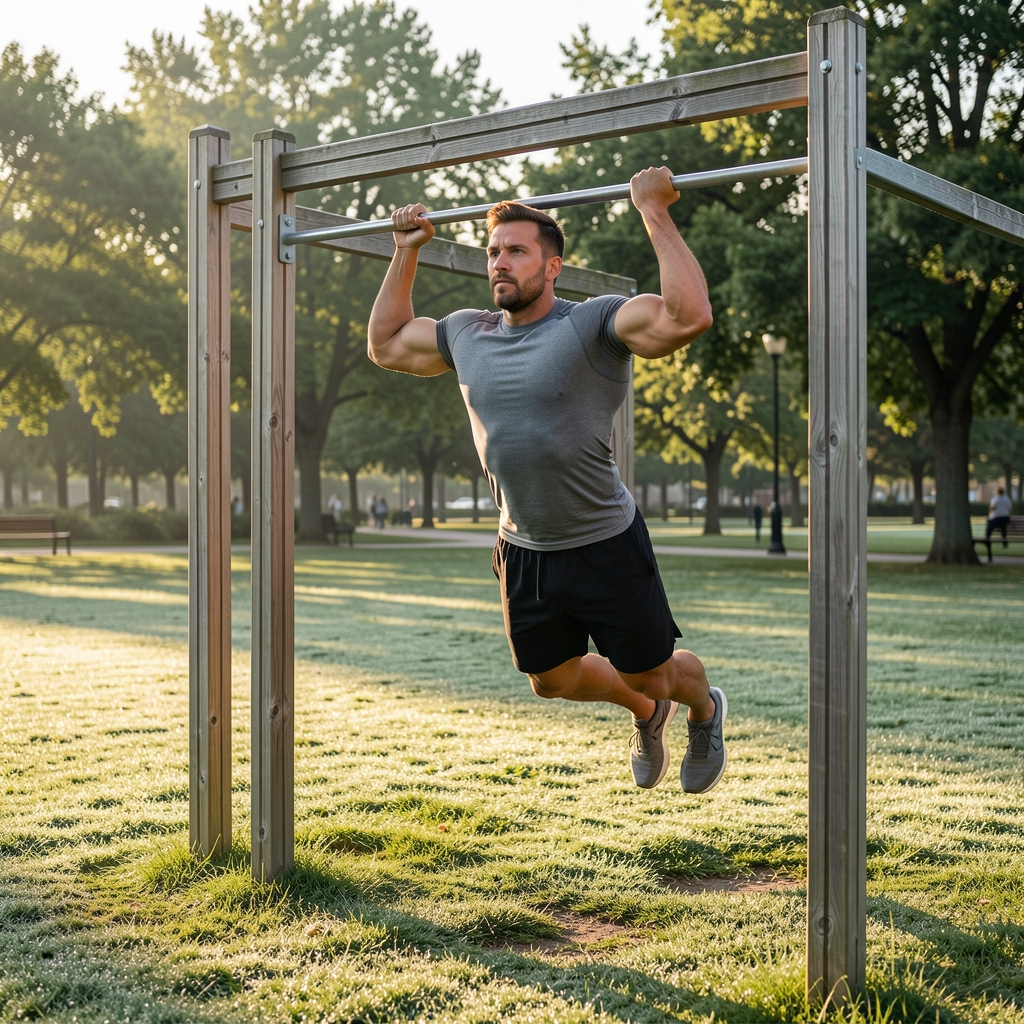
The gym is a controlled environment, and that is both its greatest advantage and its most significant limitation. Controlled resistance, predictable footing, regulated temperature — conditions that make certain adaptations easy to measure and replicate. What they do not replicate is the variability of the world the body actually operates in.
Gym training takes place predominantly on level surfaces. Machines constrain movement to a single plane. Even free-weight training in most commercial gyms occurs on rubber floors designed for uniform load distribution. This is fine for building isolated strength, but it does not prepare the body for the functional demands of uneven ground, variable slope, or the lateral instability of natural terrain.
Outdoor strength work introduces variability that no machine can replicate. A set of press-ups performed on a hillside, a sprint up a gradient, a loaded carry across gravel — these require the stabilising musculature of the hips, ankles, and core to engage in ways that flat-floor training rarely demands. The result, over time, is a more functionally robust body: one that is not only strong in isolation but capable of organising that strength across unpredictable conditions.
The evidence for improved proprioception — the body's awareness of its own position in space — through varied-surface training is well-established in sports performance research. The implication for men who train recreationally rather than competitively is that outdoor sessions, even when less precisely structured than a gym programme, add a dimension of adaptive strength that carries over into daily physical activity.
"Variability is not an inconvenience. It is the condition under which the body learns to be genuinely useful."
The appeal of a climate-controlled gym is obvious, particularly in a city like Vienna where winters are cold and often grey. And yet the literature on cold exposure and physical performance suggests that training in cool temperatures carries particular physiological value: enhanced fat metabolism, increased adrenaline output, and a degree of resilience that warm-environment training simply does not build.
This does not require extreme cold. Sessions in temperatures between 5°C and 12°C — the kind of cool, clear mornings that Vienna reliably provides from October through March — are sufficient to engage the body's thermoregulatory response. The practical effect is that the body arrives at full working intensity more quickly than in warm conditions, and the post-session alertness tends to be sharper.
There is also a psychological dimension. Choosing to train outdoors in conditions that would allow for the easier option of staying indoors is an act of deliberate discomfort. Over time, the accumulation of such small choices builds a particular quality: the willingness to proceed without the optimal conditions. This quality is not unique to outdoor fitness, but outdoor training provides a consistent, renewable context for practising it.
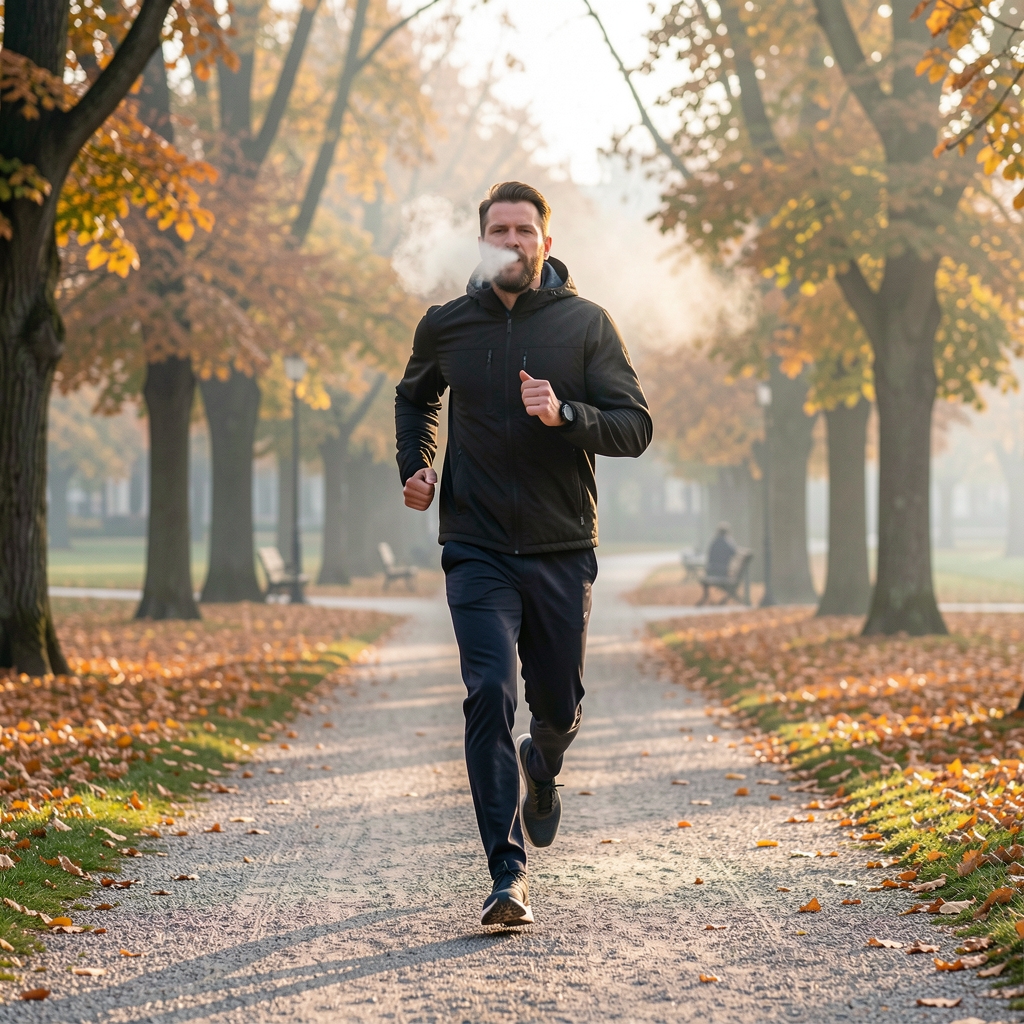
The perception that outdoor training requires specialist equipment is unfounded. A man with access to a park, a low wall, and his own bodyweight has access to a full-body strength session. The principles are identical to those that govern gym training: progressive overload, compound movement patterns, adequate volume, and recovery.
A well-designed outdoor session of forty-five to sixty minutes might include: a ten-minute run at moderate pace across varied terrain; three sets of press-up variations (incline, flat, decline using a bench); three sets of body-row if suitable bars are available, or a loaded backpack carry; two sets of walking lunges across a gradient; and a brief sprint interval sequence on a hill or open path. This structure addresses upper body push and pull, lower body loading, and cardiovascular capacity within a single session.
The body composition outcomes of consistent bodyweight and bodyweight-plus training are well-documented. For men aiming to maintain lean mass and manage body composition without access to weights, regular outdoor sessions of this kind are not a compromise — they are a viable primary programme.
Active recovery — the practice of low-intensity movement on rest days — is better supported by outdoor settings than by a gym. A forty-minute walk through a park, a slow jog along a river path, a cycle to a destination rather than a machine — these activities deliver the circulatory benefits of movement without the loading demands of a training session. Importantly, they are also more likely to be sustained over time because they exist in a richer perceptual context than a treadmill.
The relationship between time in natural environments and psychological recovery from stress is well-established. For men whose working hours are predominantly indoor and screen-based, the deliberate use of outdoor movement as a recovery tool serves a dual function: it supports the physical recovery between training sessions while simultaneously addressing the attentional fatigue that accumulates through sustained concentrated work.
Vienna's parks and riverside paths offer a particularly good resource for this kind of movement. The Prater, the Ringstrasse, the paths along the Donaukanal — these are not remarkable by global outdoor standards, but for a man who trains within a city, they are more than sufficient. The point is proximity and regularity, not grandeur.
The most common failure mode of outdoor training programmes is seasonal dropout. A man who trains outdoors consistently in April, May, and June, and then retreats entirely to the gym — or stops entirely — when October arrives, does not build the adaptive benefits that consistent outdoor training provides. The seasonal variation in his training input creates a corresponding variation in his capacity.
The solution is not extraordinary willpower but appropriate kit. A water-resistant shell layer, base-layer thermal management, and suitable footwear for wet or cold conditions make outdoor training in a Vienna winter comfortable rather than punishing. The investment in this kit is modest compared to a gym membership, and the sessions it enables are qualitatively different from anything a gym can offer.
Winter outdoor training also produces a specific aesthetic bonus: the rare satisfaction of having trained in conditions most people would not. This is not a performance of suffering — it is the quiet pleasure of a man who has arranged his life such that the weather is an irrelevance rather than an obstacle.

Tobias Whitfield is the senior editor at Dargo Gazette. He has written about men's daily practices and outdoor movement for over a decade, with a particular focus on the habits that sustain long-term energy and focus without recourse to optimisation culture.
More from Tobias Whitfield →
An examination of how the first hours of the day are structured — and why the order of those early habits has a compounding effect on focus and energy.

How a Sunday afternoon and a short shopping list can remove the daily question of what to eat — and why the answer matters more than the cooking.