
Morning Routine
The Architecture of a Morning Routine for Men
An examination of how the first hours of the day are structured — and why the order of those early habits has a compounding effect on focus and energy.
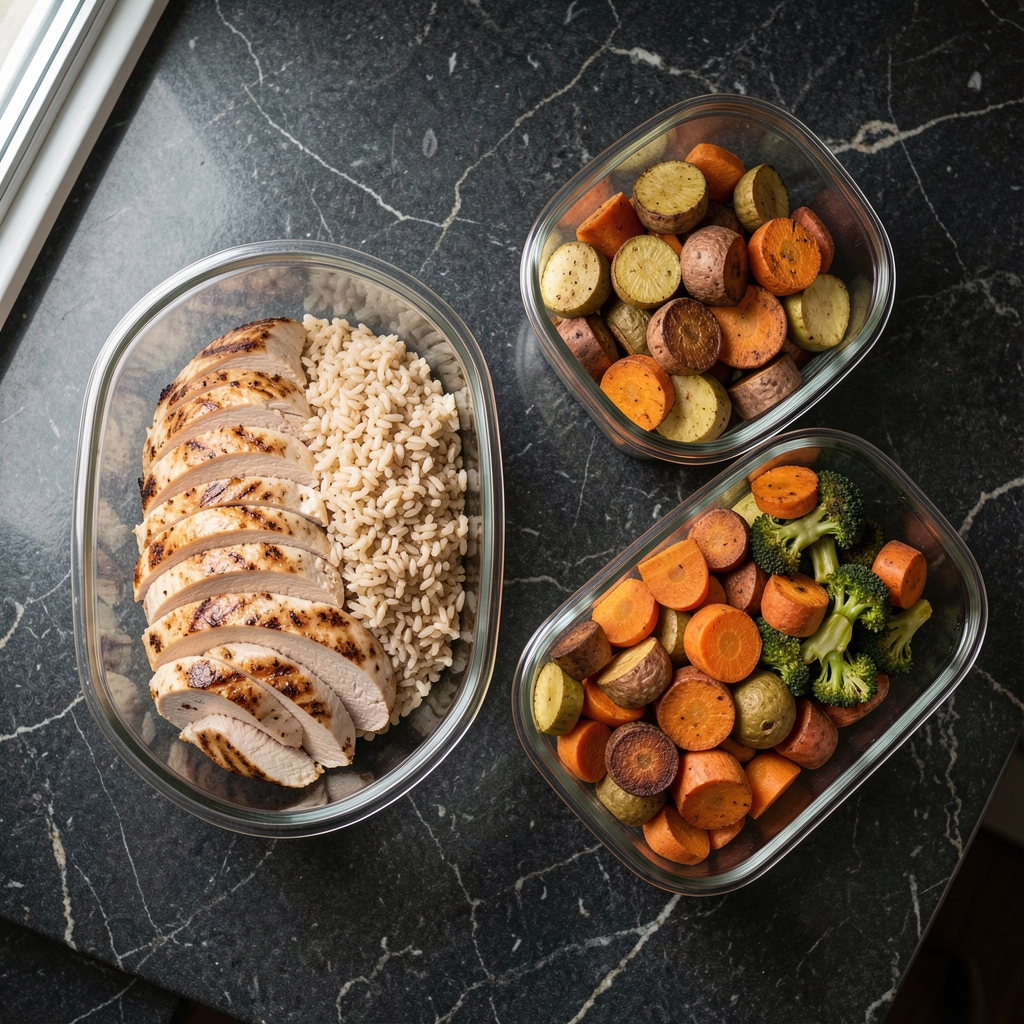
The daily question of what to eat is one of the least examined sources of decision fatigue in a man's week. It arises three times a day, seven days a week, and when answered impulsively rather than by design, it tends to produce outcomes that are expensive, nutritionally inconsistent, and rarely satisfying. Meal preparation removes the question.
Protein is the most satiating macronutrient, the most important for preserving muscle mass during periods of caloric moderation, and the one most commonly under-consumed by men who eat without planning. The current consensus in nutritional research suggests that men engaged in regular physical activity benefit from approximately 1.6 to 2.2 grams of protein per kilogram of body weight per day — an amount that is difficult to achieve consistently without some degree of intentional planning.
A weekly meal preparation practice built around a protein anchor — a single large-format protein source prepared in sufficient quantity to cover multiple meals — is the most practical way to reach this target reliably. The anchor is not the entire meal. It is the starting point: the element that takes the most time and is most likely to be skipped when a man returns home tired and hungry at the end of a working day.
Suitable anchor sources include: a whole roasted chicken (approximately 1.8 to 2.2 kg), a batch of baked chicken thighs or drumsticks, a pan of salmon fillets, a slow-cooked pork shoulder, or a large pot of legumes for those who favour plant-based sources. Each of these, prepared once on a Sunday, provides material for four to six meals through the week when combined with different grains, vegetables, and sauces.
"The shopping list is the real recipe. Everything after it is assembly."
The anchor protein is most useful when accompanied by a set of pre-cooked or prep-ready supporting ingredients that do not require daily cooking. These fall into three categories: grains, vegetables, and condiments.
Grains provide the sustained carbohydrate foundation that supports energy through the working day and post-exercise recovery. Brown rice, pearl barley, lentils, quinoa, and whole grain pasta all store well when cooked and refrigerated, and each provides a different texture and flavour profile that prevents the week from becoming monotonous. A single batch of two different grains, cooked in parallel on Sunday, provides optionality throughout the week.
Vegetables at this stage do not need to be fully cooked. A tray of roasted root vegetables (carrots, sweet potato, beetroot) takes forty minutes and virtually no active attention. Raw vegetables — cucumber, cherry tomatoes, leafy greens — require nothing beyond washing and storage. Cruciferous vegetables (broccoli, cauliflower) can be par-blanched and refrigerated, then finished quickly in a pan when needed.
Condiments and sauces are where weekly meal prep prevents the repetition problem. A batch of tahini dressing, a jar of preserved lemon and herb oil, a simple tomato sauce, and a good quality stock cuberepresent a week's worth of flavour variation that requires minimal effort and negligible cost.
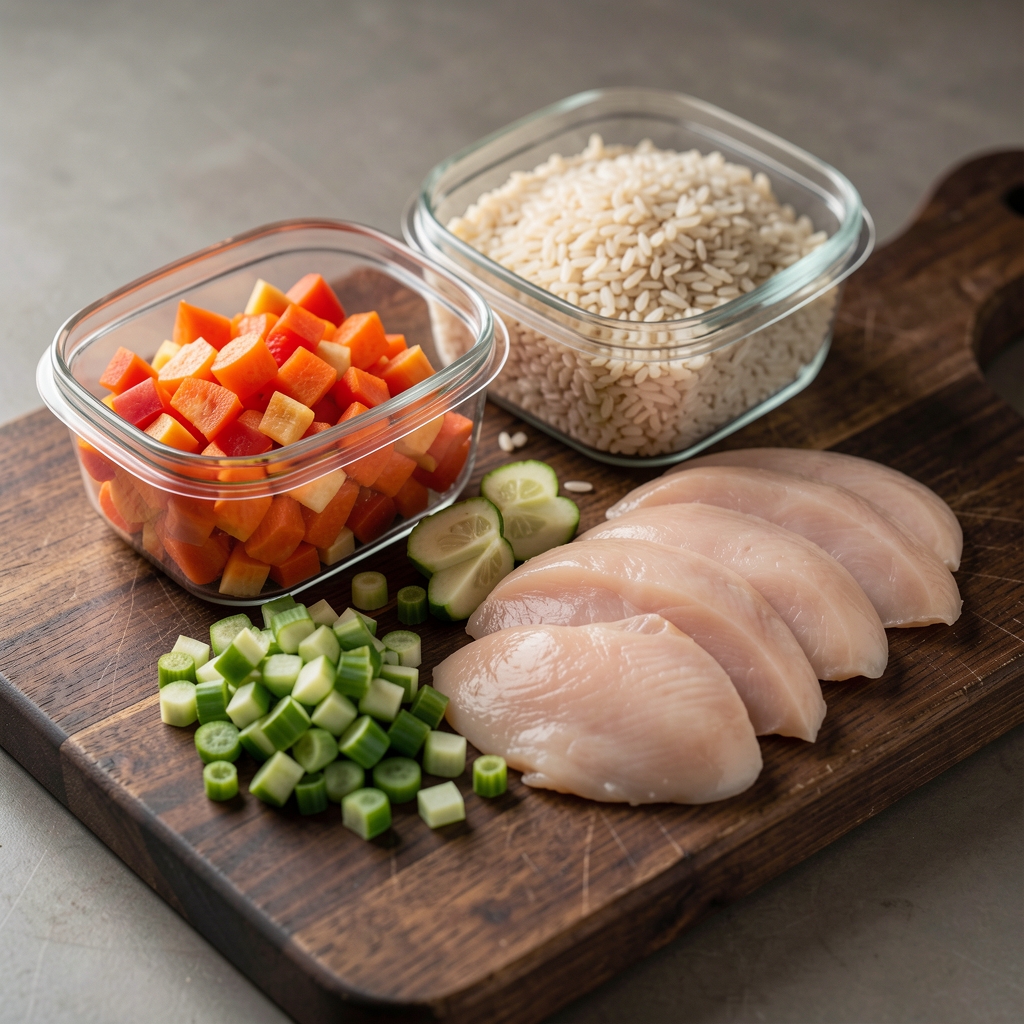
A well-run meal preparation session takes between ninety minutes and two hours, including shopping if the market is local. The key to keeping this duration stable is oven and hob parallelism: the protein anchor goes into the oven first, the grains go onto the hob, the root vegetables go onto a second oven tray, and the active preparation of raw elements occurs during the passive cooking time of everything else.
The shopping list for a week of home-prepared protein-rich meals is shorter than most men expect. For a single person, the following covers five working day lunches and four dinners: one whole chicken or 1.5 kg chicken thighs, one side of salmon (approximately 600g), two tins of good-quality legumes (chickpeas or lentils), 400g of brown rice or pearl barley, 300g of a second grain, four to six types of vegetable, eggs (eight to twelve), olive oil, and whatever condiments are not already in the cupboard.
The cost of this basket, purchased at a standard Viennese market rather than a specialist shop, is typically between 35 and 55 euros — less than two lunches in a Viennese restaurant. The nutritional quality of the resulting meals reliably exceeds anything available at the same price point outside the home.
The refrigerator, regarded as an inventory rather than a dumping ground, changes the dynamic of a prepared week significantly. When the cooked components are stored in labelled, portioned containers, the act of assembling a meal takes under five minutes. When everything is in an undifferentiated pile of unlabelled bowls wrapped in cling film, the same act becomes an excavation.
Cooked chicken and fish last four days in a refrigerator. Cooked grains last five days. Roasted vegetables last four to five days. Legumes, if stored in their cooking liquid or in water, last up to six days. Raw vegetables, properly washed and dried before storage, last the full week. This shelf life means that a Sunday preparation session provides reliable material through Thursday or Friday, with only minimal top-up required mid-week for fresh elements.
The freezer extends this significantly. Portions of cooked chicken or legumes, frozen immediately after cooling, last three months with no meaningful quality degradation. Building a small frozen reserve over several weeks provides a buffer for the weeks when Sunday preparation does not happen — which, for every man who maintains this practice over time, will occasionally occur.
The meal prep framework that covers lunches and dinners is easily extended to breakfast without significant additional effort. Overnight oats prepared in individual jars for three to four days require five minutes of active preparation on Sunday evening. Hard-boiled eggs — a useful protein supplement for any meal — take twelve minutes of passive cooking and require no further preparation.
The goal of a weekly food preparation practice is not culinary ambition. It is the quiet removal of a category of daily decisions — what to eat, when to cook it, whether the required ingredients are in the house — that consumes time and attention disproportionate to its importance. A man who has already answered these questions once, on Sunday, is free to direct that cognitive bandwidth to everything else the week requires.
The first week of this practice is always the most effortful, because the kitchen is being reorganised to support it. By the third week, the practice fits into the Sunday rhythm without friction. By the sixth, it is as unremarkable as making the bed: an act whose absence is more noticeable than its presence.

Eleanor Marsden is the Nutrition and Lifestyle Editor at Dargo Gazette. Her writing focuses on the intersection of food preparation, nutritional research, and the daily rhythms that support sustained energy and focus. She is informed by published research and a practical interest in cooking from whole ingredients.
More from Dargo Gazette →
An examination of how the first hours of the day are structured — and why the order of those early habits has a compounding effect on focus and energy.

A look at the case for taking strength training outside — and what changes when the body is working against natural ground, weather, and variable terrain.